Showing posts with label prevention. Show all posts

July 14, 2014

Consolidated guidelines on HIV prevention, diagnosis, treatment and care for key populations

People at higher risk of HIV infection are not getting the health services they need, according to a new report by the World Health Organization entitled Consolidated guidelines on HIV prevention, diagnosis, treatment and care for key populations.
Released on 11 July, the publication warns that failure to provide adequate HIV services for key groups, such as men who have sex with men, people in prison, people who inject drugs, sex workers and transgender people, threatens the global progress of the HIV response.
The consolidated guidelines outline the steps for countries to take to reduce new HIV infections and increase access to HIV testing, treatment and care services by populations at higher risk. The report aims to provide a comprehensive package of evidence-informed HIV-related recommendations for all populations, increase awareness of the needs of and issues important to key populations, improve access, coverage and uptake of effective and acceptable services, and catalyse greater national and global commitment to adequate funding and services.
"Failure to provide services to the people who are at greatest risk of HIV jeopardizes further progress against the global epidemic and threatens the health and well-being of individuals, their families and the broader community."
Gottfried Hirnschall, Director of the HIV Department at the World Health Organization
source: UNAIDS

July 17, 2012

FDA approves first drug to prevent HIV infection


Dr. Lisa Sterman holds up a Truvada pill at her office in San Francisco in May. Even before the Food and Drug Administration's approval, Sterman had prescribed Truvada for about a dozen patients at high risk for developing AIDS. Photo by Jeff Chiu/AP
The Food and Drug Administration has given the first OK for a drug to prevent HIV infection.
The daily pill Truvada, made by Gilead Sciences, combines two medicines that inhibit the reproduction of HIV. It's been a mainstay in the treatment of HIV/AIDS for years, and as of today is an approved option for reducing the risk of HIV infection for people at high risk.
The drug was approved for people who test negative for HIV infection. It's supposed to be used in combination with safe-sex practices, such as using a condom, to reduce infection risk. "Truvada alone shouldn't be used to prevent HIV infection," FDA's Dr. Debra Birnkrant, said in a media briefing.
People taking Truvada should be tested for HIV infection every three months, so treatment can begin promptly if an infection has occurred.
An outside panel of experts had recommend the agency take the action after concluding that the benefits to healthy people vulnerable to HIV infection outweigh the risks, including such side effects as kidney damage and a dangerous increase in acid in the blood.
About 50,000 people in the U.S. become infected with HIV each year, according to the Centers for Disease Control and Prevention. The majority of new infections are in gay or bisexual men.
Birnkrant said the steady rate of new infections showed that more options are needed to reduce transmission of the virus. "Truvada for pre-exposure prevention represents another effective evidence-based approach," she said.
But the cost for prevention isn't trivial. The annual tab for Truvada ranges from about $11,000 to $14,000.
In an interview with Talk of Nation's Neal Conan in May, the National Institute of Health's Anthony Fauci, said of Truvada, that it's "an important component of the broad tool kits that we do have for prevention."
He acknowledged the risks, such as side effects, and the possibility that some people taking the drug might engage in riskier behavior because they think they're protected.
In response to a question about that from NPR's Richard Knox today, FDA's Birnkrant said studies of Truvada for prevention found an increase in condom use over time — not a drop. (Listen to Knox's story on Monday's All Things Considered for more.)
During the Fauci interview conducted shortly after the expert panel recommended FDA approval of Truvada for prevention, he said, "I agree with the advisory committee strongly that when you balance the benefits of this, making this available, to the risks, ... the benefits far outweigh the risks, although you must take seriously the potential downsides of it and be prudent in your use of this."
source: NPR

September 6, 2009

Circumcision to fight HIV

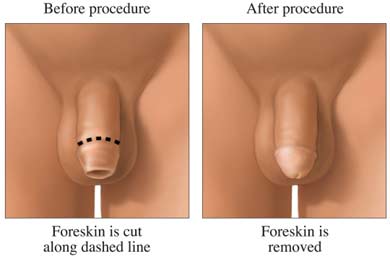
Public health officials are considering promoting routine circumcision (surgical removal of the foreskin of the penis) for all baby boys born in the United States to reduce the spread of HIV, the virus that causes AIDS.

The topic is a delicate one that has already generated controversy, even though a formal draft of the proposed recommendations, due out from the Centers for Disease Control and Prevention by the end of the year, has yet to be released.

Experts are also considering whether the surgery should be offered to adult heterosexual men whose sexual practices put them at high risk of infection. But they acknowledge that a circumcision drive in the United States would be unlikely to have a drastic impact: the procedure does not seem to protect those at greatest risk here, men who have sex with men.

Recently, studies showed that in African countries hit hard by AIDS, men who were circumcised reduced their infection risk by half. But the clinical trials in Africa focused on heterosexual men who are at risk of getting HIV from infected female partners.

For now, the focus of public health officials in this country appears to be on making recommendations for newborns, a prevention strategy that would only pay off many years from now. Critics say it subjects baby boys to medically unnecessary surgery without their consent.

Clinical trials in Kenya, South Africa and Uganda found that heterosexual men who were circumcised were up to 60 percent less likely to become infected with HIV over the course of the trials than those who were not circumcised.

Members of Intact America oppose circumcision on broad philosophical and medical grounds, Ms. Chapin argued that the studies in Africa found only that circumcision reduces HIV infection risk, not that it prevents infection. “Men still need to use condoms,” Ms. Chapin said.

In fact, while the clinical trials in Africa found that circumcision reduced the risk of a man’s acquiring HIV, it was not clear whether it would reduce the risk to women from an infected man, several experts said.

“There’s mixed data on that,” Dr. Kilmarx said. But, he said, “If we have a partially successful intervention for men, it will ultimately lower the prevalence of HIV in the population, and ultimately lower the risk to women.”

Circumcision is believed to protect men from infection with H.I.V. because the mucosal tissue of the foreskin is more susceptible to HIV and can be an entry portal for the virus. Observational studies have found that uncircumcised men have higher rates of other sexually transmitted infections like herpes and syphilis, and a recent study in Baltimore found that heterosexual men were less likely to have become infected with HIV from infected partners if they were circumcised.

source: The New York Times

picture by S H HO urology and laparoscopy center

August 3, 2009

VivaCell-MTS and Armenian Red Cross Society Together for Humanity

On July 31, 2009 VivaCell-MTS and Armenian Red Cross Society (ARCS) joined hands to address humanitarian challenges facing the state and society. The two Organizations signed a Memorandum of Understanding for this purpose during a press conference at the Headquarters of the Armenian Red Cross Society.

Because we care! A notion that gathered the efforts of two of the biggest organizations in Armenia: The Red Cross ARCS and VivaCell-MTS. Both having the best interest of the support of vulnerable groups at heart, joined hands for the society’s welfare.

The long term cooperation between the ARCS and VivaCell-MTS will start with a very vital cause, the fight against the HIV virus, the millennium’s merciless evil. Realizing the importance of awareness in prevention of the virus, the two organizations come together to raise population’s awareness on prevention of HIV/AIDS. The activities will be multi-staged and will involve a wide range of educational events: spread of information materials, public events, etc. Within the framework of the activities, all kind of print materials with brief information on HIV/AIDS and alarming messages and guidance tips and advises will be available to all the Armenian society to benefit from.
“Today VivaCell-MTS and Armenian Red Cross Society have come together to join their efforts to address the needs of the most vulnerable population and to provide them with reachable and effective support. Join us, don’t stay indifferent to the pain of others”, mentioned in the speech the leader of the Armenian Red Cross Society.
“We owe our society the right to know! With knowledge and awareness we can better prevent and fight any disease. Awareness and prevention are each and every one’s responsibility and tolerance is required when dealing with HIV cases. Because we care we are here today, what about you?” asked VivaCell-MTS General Manager Ralph Yirikian.

The press conference started with a very significant yet meaningful action taken by the leaders of both organizations, together with their staff of volunteers, who did a blood testing with the purpose of HIV investigation

source: VivaCell-MTS

March 28, 2009

TB/HIV, universal access, and human rights key items

The Executive Director of UNAIDS, Mr Michel Sidibé, was in Brazil promoting greater awareness of the interlinked epidemics of HIV and tuberculosis, the need for universal access to HIV services for all people in need, and the necessity to address stigma and discrimination in Brazils response to HIV.

On March 24, 2009 in Rio de Janeiro, Mr Sidibé joined the international launch of the World Health Organizations (WHO) annual report on global TB control.

Although it is mostly preventable and curable, tuberculosis (TB) is one of the leading causes of death among people living with HIV globally. Of the 33 million people who are living with HIV, only 20% of know their status, and only a tiny fraction, 2% in 2007, were screened for TB according to the Global TB Control 2009 report.

"We have to stop people living with HIV from dying of tuberculosis. Universal access to HIV prevention, treatment, care and support must include TB prevention, diagnosis and treatment. When HIV and TB services are combined, they save lives," said Mr Sidibé.