Showing posts with label LGBT rights. Show all posts

November 15, 2014

Armenian LGBT news website launched

For the first time in Armenia a website has launched specifically for LGBT news. The website is a project financed by the Embassy of the Kingdom of Norway. The main purpose of the website is the dissemination of local and international news and information concerning LGBT community.

The website has “legal” and “psychological” sections, in terms of which the website cooperates with PINK Armenia. It gives LGBT people an opportunity to anonymously write about legal or psychological issues they face, and receive responses from well-trained specialists.

With informative current articles, interviews and researches, LGBTnews.am provides an alternative online platform in Armenia targeted directly to the LGBT community, to raise awareness on LGBT issues, tell stories, and make the LGBT voices heard.

We are convinced that LGBT news Armenia will bring its contribution to the lesbian, gay, bisexual and transgender liberation movement in Armenia.

July 2, 2013

Are we on the right side of history?

AGLA NY at Pride March 2013
Photo by Engin Beri
In a landmark ruling for Gay, Lesbian, Bisexual and Transgender (LGBT) rights, the Supreme Court of the United States on Wednesday struck down the Defense of Marriage Act (DOMA), the 1996 law signed by then President Bill Clinton blocking federal recognition of same-sex marriages. In a separate case, the court ruled that it could not take up a challenge to Proposition 8, the California law that banned same-sex marriage in that state. That decision means that marriage equality will once again be legal in California.

This is a watershed moment in the fight for equality with the Supreme Court delivering justice to millions of Americans and to the thousands of LGBT Armenian-Americans who have been denied their rights under the U.S. Constitution.

Yet it is increasingly clear that we now have two Americas – one where our relationships are recognized and we are protected from discrimination in 13 States and the District of Columbia, and another that has yet to feel the effects of our progress and LGBT people remain second-class citizens, including in the State of Florida.

Sadly, we find many LGBT Armenian-Americans living under this same pretext for far too long – in an America that celebrates and protects who we are as Armenians and the other in our community centers and churches that marginalize and stigmatize LGBT Armenians for whom they love. No one should choose between who they are and whom they love.

I recognize that there are deeply held views on this issue and deeply fierce opposition by the Armenian Church hierarchy. But we cannot pretend to be a nation seeking restorative justice and recognition of our painful history and add the word “but” if we are truly genuine in our collective quest for justice for all.

This is a debate about equal rights under the law. It is about freedom from discrimination and stigmatization the way we were once discriminated and stigmatized as Christians in the Ottoman Empire. It is about the legal protections and responsibilities, and more than 1,100 rights, obligations and benefits afforded by the legal institution of marriage that, prior to the DOMA ruling, were denied to same-sex Armenian American couples. It is also about real people: your sons, daughters, brothers, sisters, and neighbors. And finally, it is about witnessing and reflecting the love and commitment between two people.

Given our 1,700 years of Christian heritage, I’d like to sum up the whole law in a single commandment, “You shall love your neighbor as yourself” Galatians 5:15.

For if truly we, as the Armenian nation, are on a quest to bend the arc of the moral universe towards justice for all, then surely we must stand on the right side of history by resisting all forms of bigotry and dedicating ourselves to the advancement of social justice and human dignity of both the living and the deceased.

And if truly we belong to the body of our Lord Jesus Christ through the One, Holy, Catholic (Universal) and Apostolic Church, then surely we are commanded to love, treat with respect and defend our LGBT Armenian sisters and brothers and any other marginalized groups both in the U.S. and in our beloved Hairenik (fatherland), no matter what your Biblical conviction is on homosexuality. This we know as absolute: Christ’s ministry was inclusive and he said that if we commit hate in our hearts we have committed murder – thus, we should take discrimination, hate-talk and the bullying of any marginalized group very seriously. If our tragic history hasn’t taught us anything, then I do not know what will. To learn more specifics on how the Supreme Court rulings on DOMA and Prop 8 might affect you, please visit www.hrc.org/SCOTUS.

Michael Toumayan
source: Florida Armenians

Michael Toumayan is a program assistant at the Human Rights Campaign and an independent political commentator on the Caucasus and Middle East.
A graduate of Florida Atlantic University in Boca Raton, Florida, he holds a master’s degree in conflict resolution and mediation from Tel Aviv University in Tel Aviv, Israel. He can be reached at michael.toumayan@hrc.org.

July 20, 2012

Armenia answers to the Committee, avoids subject of LGBT


Geneva 17 July 2012.  The United Nations Human Rights Committee finalized the examination of the third periodic report of Armenia today, which took place on 16 and 17 July 2012.

In some areas of the dialogue between the Committee and the State delegation, the discussionwas progressive. In others, the Committee expressed concern about the lack of information provided by the State. The delegation was often pressed by the Committee for more specific, statistically based answers to some of its questions. When faced with inquiries regarding the March 2008 post-election violence in Armenia, the delegation offered little explanation as to the lack of investigation into, and criminal accountability for, the resulting deaths.

The Committee otherwise focused its attention on issues of gender-based violence, trafficking in human beings, prison conditions, corruption in the judiciary, and discrimination. One committee member challenged the State to “put its money where its mouth is, and provide necessary funding to combat gender-based violence”. The Committee took particular issue with the State’s attitude toward members of Armenia’s LGBT community. The Committee received information that a government official previously announced that LGBT individuals were “a threat to national security.” Explanations from the State regarding the measures currently undertaken to protect the human rights of these vulnerable individuals were noticeably sparse.

Having received information from independent sources regarding the objectivity of Armenia’s judiciary, the Committee confronted the delegation with allegations that the judiciary is dependent on the executive branch, and that judges tend to have a bias toward the prosecution. The Committee was deeply concerned about reports from NGOs stating that judges operate under the notion that justice is negotiable, and can be bought for the right price.

The Committee also reminded the delegation that it has been a party to the Optional Protocol for Individual Communications for twenty years. In that time, there has not been a single casesubmitted to the Committee by an individual victim of human rights violations. As such, the Committee questioned whether the State has actually made it known to the Armenian people that this important recourse is available to them.

Armenia was given forty-eight hours to address unanswered questions posed by the Committee –indicating that, after six hours of intensive dialogue, the Committee felt it needed more information from the State. Armenia must be forthcoming about the true state human rights in the country, and ensure the enactment and implementation of its pending human rights legislation and programming. These active measures are critical to demonstrating the State’scommitment to protecting the human rights of all Armenian people.

The Human Rights Committee will make its recommendations public at the end of its session, on 27 July 2012. The archived webcast of Armenia’s review can be seen at treatybodywebcast.org.For additional information on the review of the Armenia contact: Centre for Civil and Political Rights (CCPR): www.ccprcentre.org /

info@ccprcentre.org(Centre for Civil and Political Rights/Ashley Tucker)

May 18, 2012

AGLA NY’s Statement In Response to the May 8th Terror Attack in Yerevan


For immediate release
May 17, 2012
Press contact: nancyagabian@yahoo.com

The Armenian Gay and Lesbian Association of New York is appalled by the terrorist firebombing of DIY bar on May 8 and the subsequent hate crimes against the establishment this past week. We also condemn the proliferation of verbal, Facebook, Youtube and other online attacks lodged against the queer community of Yerevan. Furthermore, we denounce acts of hate speech and threats against anyone in Armenia deemed different or “threatening to society”, including artists, intellectuals, and other free-thinkers.

Most despicable are the words and actions of Dashnaktsutyun MP Artsvik Minasyan, who financially sponsored the bail for one of the two neo-fascist attackers of DIY and who recently deemed their actions “in accordance with national ideology.” In the same interview with Panorama News Agency, Minasyan targeted the manager of DIY, Tsomak Oganesova, stating that “her kind are destroying Armenian society.” Such statements may be used to justify violent acts against hundreds if not thousands of peaceful, law-abiding citizens. To date, there has been no official call from Dashnaktsutyun or the Armenian government to investigate Minasyan or to take him to task: this is unacceptable. In the meantime, Minasyan is violating Dashnak philosophy and continues to issue egregiously homophobic and harmful statements under their banner. The Armenian Parliament and Dashnaktsutyun should reprimand Minasyan, ask him to resign or remove him from office immediately for inflaming conflict and endangering lives.

Today on May 17, the International Day Against Homophobia, AGLA NY stands in unity with our partnering organizations PINK, the Women’s Resource Center, Queering Yerevan, and others to call for tolerance and a renewed commitment to human rights among individuals and institutions, in Armenia and in the diaspora. Most importantly, to the LGBT community in Armenia who are living under dangerous circumstances, we offer our undying support.

Founded in 1998, the Armenian Gay and Lesbian Association of New York (AGLA NY) provides a space for lesbian, gay, bi and transgender Armenian-Americans, their partners and their allies to come together as a community. It is a forum which fosters our visibility and strengthens our cultural and ethnic ties to the queer communities and Armenian communities to which we each belong. The purpose of AGLA NY is also to inform both the Armenian and American communities about issues of importance to LGBT Armenians and Armenian-Americans, as well as the larger American community. For more information, visit AGLA NY at http://aglany.org or email info@aglany.org.

April 18, 2012

Day of silence

On April 20 we keep silent to be heard, what do you do to break the silence?

The main purpose of this day is to get the public’s attention, by raising awareness on the issues of violence, intolerance, harassment, and discrimination and by developing relevant and effective solutions in an effort to eliminate them. The International Day of Silence is directed to the world wide public and aims to capture people’s attention on the spread of hate crimes against LGBT communities, homophobia, bullying, physical and psychological abuse, discrimination and intolerance. Every year, thousands of people take part in the events dedicated to the Day of Silence in an effort to increase participation and activism for the reduction of homophobia in educational institutions. This is an opportunity to show the public that this problem concerns not only the LGBT people, but also us, our family members, relatives, friends and all layers of the society.


Day by day, thousands of people keep silent. They keep silent because they are afraid. They keep silent because they are what they are. Our brothers, our sisters, our parents, our friends and coworkers are among them, homosexuals and heterosexuals keep silent, you keep silent and I also keep silent. This is the silence of the entire lesbian, gay, bisexual and transgender people about discrimination, violence, harassment, which they permanently face. On this day, their silence will be heard all over the world. Millions of people will keep silent in different parts of the world, regardless of their nationality, religion, sex, age, profession, sexual orientation and other personal qualities. They will keep silent because they believe that harassment and discrimination must end. In countries where LGBT rights are better respected, they will keep silent for the educational institutions on its mission to become safer for everyone, regardless of nationality, sexual orientation or other personal characteristics. Finally, in countries where LGBT rights are not protected, the Day of Silence is dedicated to the elimination of homophobia and prevention of hate crimes. People are taking part in the Day of Silence to elucidate this issue and let LGBT people feel that they are not alone.

February 26, 2012

Report: LGBT rights situation in Armenia 2011

LGBT rights violation can be witnessed in various spheres of social life. LGBT people state that there is discrimination toward them in educational institutions and there were cases when a person was bullied by a teacher because of being feminine (in case of a male person) or masculine (in case of a female person), forced to drop out from the university because of his/her sexual orientation. Scientific papers and work on this issue is not welcomed, because the stance of the lecturers is that it is a perversion and the person is perverted if he/she wants to work on this topic. A gay student was not allowed to write a paper about homosexuality as the lecturer stated that he can’t be objective taking into account his sexual orientation.

Employment remains one of the most problematic aspects of life for LGBT people as employers refuse to hire someone who is open about his/her sexual orientation or his either feminine (gay) or masculine (lesbian). Transgender people have no opportunity to be open about their gender identity and there is no relevant legislation which will allow transsexual persons to change sex. Quite often LGBT people refuse to visit healthcare institutions in case of a necessity being not sure about the confidentiality there. If they contact civil society organizations they are being referred to LGBT friendly doctors, otherwise there is a high risk that person will be discriminated and will receive degrading attitude.

Army remains one of the most challenging institutions due to its closed nature and non-written rules which exist there and lead to discriminative and violent approach toward this group of people. In most of the cases media approach toward LGBT people is biased and based on stereotypes, prejudice and has no scientific and contemporary approach. There is no political willingness from the side of government institutions to protect LGBT rights and quite often they appear in the position of violators.

The stance of civil society toward LGBT rights is not united as well. Despite the fact that civil society organizations are able to work in the sphere of LGBT rights protection and take actions for changes, there is no support from the government and public and some part of civil society.

Although there are no radical changes in the above mentioned aspects, in this report we will focus on several aspects of social life and will present most common issues and problems of LGBT community in the Republic of Armenia which were registered in the past 2011.

Read more about the attitude of society, media, church, police and achievments in 2011 in our official website

August 17, 2011

Interview with the president of PINK Armenia

Original post at the Neutral Zone

- Dear Mamikon, what is the overall situation with the LGBT community in Armenia today? What are the key challenges of the community?

People in Armenia still live with taboos and stereotypes and in many cases they mix tradition, religion, customs, habits and reality. In the past LGBT people were hiding because of intolerance, hate and ignorance, and the society thinks that we didn’t have gays at all and that this is something modern and European. In general, today people call whatever they don’t like ‘a European value’, for example gender equality, women’s role in the government and so on, but let me bring an example. What was Europe doing when at the beginning of the 20th century Armenia had women in the parliament and women diplomats? So human rights protection is a universal value and it belongs to Armenia as well.

LGBT still live with a fear and most of them are in closets. The majority doesn’t know anything about sexual orientation and gender identity, even they think that “having a different sexual orientation is immoral,” Neo-Nazi groups even say that heterosexuality is also immoral. These things show that the lack of education and knowledge makes people aggressive and they start to oppose anything they do not understand.

- What are the attitudes: in the society, families, workplace, media toward LGBT? Any changes in this respect in the last 5-10 years?

Our research on LGBT rights and violations in 2010 says that discrimination mainly starts in families and goes wider to schools, workplace, healthcare services, actually everywhere. The media usually promotes hate toward the LGBT community and we don’t have any laws to stop hate speech. Nowadays it is possible to find a few tolerant electronic media or newspapers, but the majority is homophobe, especially TV.

For example “Iravunk” daily often promotes hate crime and they present it as freedom of speech but actually freedom of speech and human rights violation are two different things and in civil and developed counties hate promoters are punished by law. On TV they use the theme of homosexuality for jokes, teasing it as an abnormal and immoral behavior. During the last 5-10 years LGBT people became more or less visible and LGBT issues are on the top of the discussion list. Whether the reaction of the society is positive or negative, the visibility of LGBT issues brings small changes.

-What is the relationship between the law and the LGBT community? Is the law discriminatory or does it protect the LGBT rights?

Homosexuality was decriminalized in 2003 but we don’t have any laws to protect LGBT people, to prevent violence, discrimination or hate speech. There aren’t any anti-discrimination laws in Armenia.

-Are there cases of violence against the LGBT community?

There are many cases of violence against the LGBT community, but mainly they are not registered as violence against LGBT or those cases are not registered at all. Cases of violence can be found everywhere, but for the most part they take place in schools, healthcare sector, police stations and army.

-Are there any positive developments?

The latest positive development was the Ombudsman’s cooperation with PINK, when we signed the Memorandum of Understanding and he announced that he and his team are ready to protect the rights of all people in Armenia and cooperate with human rights organizations. Another positive development is the existence of tolerant journalists and a few newspapers that cover LGBT issues.

The existence of networks and coalitions that support human rights brings positive changes into the society. One drop in the lake is not a big deal but later those drops will make a river and it will run to the lake.

- Is there anything else that you would like to add?

The Armenian Church, as they say, should be tolerant, spread peace and respect, but they are one of the main institutions that spread hate and intolerance against LGBT people. The topics they touch or present always come back to homosexuality and start to blame. In a recent case we had in Armenia, when the representatives of religious minorities and the Armenian Church had a conflict, during the press conference the priest talked about that conflict and religious minorities for a couple of minutes and then the whole press conference was related to homosexuality. On the other hand, it was the journalists who provoked the priest asking irrelevant questions, but the priest replied to their questions with pleasure blaming gays.

In Armenia, people still don’t know all the terms regarding LGBT issues. Many Armenians even think that gays are those who wear dresses, have make-up and behave like girls. As I mentioned, the lack of knowledge and information doesn’t let them to recognize the difference between gay/lesbian, bisexual and transgender people.

By Phil Gamaghelyan

July 15, 2011

Homophobic and transphobic violence must be stopped

A few weeks ago, a peaceful Pride demonstration in Split, Croatia, was brutally attacked by thousands of hooligans, wounding over a dozen people. The counter-demonstrators by far outnumbered the police officers and Pride participants. The police did not fully succeed in protecting the demonstrators, who simply wanted to raise awareness about the situation of lesbian, gay, bisexual and transgender (LGBT) persons. These events unfolded after weeks of hate speech, threats, graffiti, flyers and social media inciting to hatred.

This is not the first time a manifestation against homophobia and transphobia has suffered assaults and threats from extremists.

In 2010 in Belgrade, Serbia, the police made heroic efforts to protect the first ever Belgrade Pride, but around 150 persons were injured during the confrontations, most of them police officers. Again, the counter-demonstrators outnumbered by far those marching in favour of LGBT rights.

In Vilnius, Lithuania, in 2010, the authorities had to mobilise a large police contingent to shield the Baltic Pride March from violent attackers.

There is a growing awareness among local authorities that peaceful Pride events must be allowed and protected; LGBT persons have the same rights as others to freedom of assembly and expression. This acknowledgement is of course positive.

The continued need for massive police protection however is very negative. It is high time for European politicians to seriously tackle the phenomena of homophobia and transphobia and their root causes. The first step is to recognise that the problem is serious and that systematic action is needed to promote awareness on all levels in society. Then there is an urgent need to counter all tendencies of discrimination against this group of people - also in official human rights and equality policies.

In the past five years I have monitored the implementation of human rights for LGBT persons in the 47 member states of the Council of Europe. The result was recently published in a report: Discrimination on grounds of sexual orientation and gender identity in Europe.

The report lists a number of obstacles to the full enjoyment of their universal human rights. It shows, for example, that homophobic and transphobic harassment in the workplace and bullying of LGBT persons in schools is common in practically all member states. The official registration of LGBT organisations was obstructed or refused in five countries in Europe, and attempts to criminalise “propaganda or promotion of homosexuality” were identified in three member states.

There has been little response to national studies and reports which flag that a disproportionate number of young LGBT persons see no other way out than committing suicide due to the non acceptance of their sexual orientation or gender identity by their peers and families. Very few countries recognise homophobic or transphobic violence in their hate crime legislation.

Transgender persons face particularly severe human rights problems in almost all areas of life. If they want their preferred gender to be legally recognised, in 29 member states they face a legal requirement to undergo gender reassignment surgery, leading to infertility. Some 15 member states even require the transgender person to be unmarried in order to obtain recognition, which entails mandatory divorce if the person is already married.

Too often politicians and policy makers ignore the human rights of LGBT persons when designing policies or drafting legislation. There are disturbing examples of debates in national parliaments which are characterised by a high level of prejudice, bias and outdated information, including claims that homosexuality is an illness

Governments need to pursue legislative reforms and social change to enable LGBT persons to fully enjoy universally recognised human rights. National and international monitoring, including by Equality Bodies and Ombudsman Offices, is needed to measure progress.

Change is only possible if European countries show more genuine political will to address this problem with much more determination than has so far been demonstrated.

Thomas Hammarberg
Council of Europe Commissioner for Human Rights

June 23, 2011

Council of Europe launched its first and the comprehensive European study on the human rights situation of lesbian, gay, bisexual and trans people to date

Today, the Council of Europe launched its social-legal report on discrimination on the grounds of sexual orientation and gender identity. This is the first ever report covering all 47 member states of the Council of Europe on a range of human rights issues that are pertinent to lesbian, gay, bisexual and trans (LGBT) people.

ILGA-Europe warmly welcomes this significant report which not only maps the legal situation but also highlights the social attitudes and opinions about LGBT people: while there is certain progress in some countries, others continue discrimination and violation of basic human rights of LGBT people.

When it comes to social attitudes, the report clearly demonstrates that LGBT people continue to be subjected to homophobia and transphobia in their everyday lives in all Council of Europe member states and those attitudes are being based on ‘outdated and incorrect information’ about sexual orientation, gender identity and gender .

The report contains a number of specific recommendations to the Council of Europe member states on how to end discrimination and ensure full equality for LGBT people. It also provides a number of recommendations on non-legislative measures such as state education programmes aiming to increase awareness and understanding of various sexual orientations and gender identities and therefore promote improvement of the social attitudes based on facts and objective information.

Martin K.I. Christensen, Co-Chair of ILGA-Europe’s Executive Board, said:
“This is a very important document which looks at the issues of equality and human rights of LGBT people from different angles and provides clear recommendations and suggestions to the Council of Europe member states. There is clear and urgent need to improve legislation to achieve full equality and respect for human rights. The legislation also needs to be supported by proper implementation plans and mechanisms to give its full and practical meaning. The report also looks at the issues of political will, social attitudes and current European consensus and again, provides a range of specific suggestions how the situation can be improved.

We hope that this report along with the Council of Europe’s Committee of Ministers Recommendations adopted in March and a number of the judgements by the European Court of Human Rights, will provide European countries with a solid road map towards full equality and respect of LGBT people’s human rights. We believe there is sufficient European consensus and legal foundation for such improvement, all is required to fill the existing gaps is a political will of the national governments to bring their countries in line with the expected European standard.”

June 21, 2011

They leave behind their lives to crawl toward the future

Where have I come from? Where shall I go? Where is the place you await me to come to? Or isn't there anybody waiting for me?

People around the world leave their motherland, leave the places where they grew up and used to live. They leave it for professional or personal reasons in some cases but the main factors can be war, hate, discrimination, nazism, intolerance, frustration, stress, ignorance, aggression. The main thought which remains in your mind is to run away, to disappear and to save your soul... or to stay and to struggle and even to die.
World, you cut and paste, you drag and drop refugees all around you!
Anahit Hayrapetyan
One may become a refugee, because he can’t live on the land which was occupied after a war or a genocide.
The other one flees, because political views and activism can cause a danger.
And you are a refugee now, because your characteristic features are not acceptable for the compatriots.

Hundreds of thousands of Armenian refugees crossed the border and never came back, they went to find their freedom under the shadows of western democracy that Armenia could never insure. Among them were those whose feelings and emotions were not accepted by the majority, their sexual orientation and gender identity were not considered as traditional, their life became endangered in their own homeland, and peace was somewhere far away. Those people are gay, lesbian, bisexual, trans, intersex and queer; those people are considered as strangers on their own land.
The refugees that flee, they leave behind their lives to crawl toward the future.
Anahit Hayrapetyan
photo by Karen Mirzoyan, 2008
(photo is cropped)
When you left me alone to find your freedom, you took my heart with you, you put it in your baggage next to your scarfs and shirts, you left and never came back to see me, you cried but never showed your tears, you just gave me the last kiss to live with and I feel it on my lips even today. Then we realized that happiness was not here and not there, it was with us when we were together. You are a refugee in a foreign society but I feel as a refugee even in my own land, because they always say: “This is not your country”. Neither here nor there, where do I belong and where do you belong?

Iranians escape to Armenia, Armenians escape to Russia, Russians escape to Europe and it goes on and on.

But we are here we are queer and this is our world, too!


Director: George Barbakadze
Writers: George Barbakadze, Fleurtasha Cooper

June 16, 2011

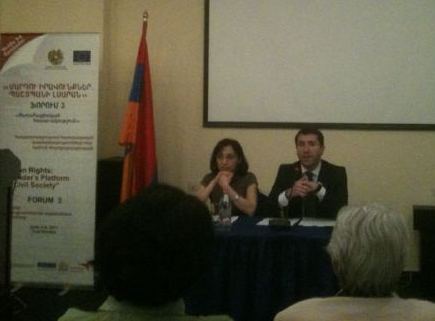
Human Rights. Defender’s platform. Civil Society

On 3-4 June 2011 Office of the Human Rights Defender of the Republic of Armenia (HRDO) convened already third forum in series of forums entitled “Human Rights. Defender’s Platform”. This time forum entitled “Civil Society” was dedicated to the partnership with civil society organizations and brought together 130 participants from more than 85 human rights NGOs, international organizations, attorneys and media. Forum was supported by the European Union, World Vision Armenia and Organization for Security and Co-operation in Europe.

The aim of the “Civil Society” Forum was to strengthen cooperation and promote active dialogue between the Office of the Human Rights Defender and leading human rights NGOs specialized in the issues of minorities, refugees, children, disabled people, women, military servicemen, rights of persons in detentions and penitentiaries, environmental rights, rights of the persons suffered from violence and torture as well as NGOs promoting the right to a fair trial and the right to freedom of expression.

Followers of @pinkarmenia twitter had possibility to read live tweets of our representative, Mamikon Hovsepyan, who used #CSforum and #HRArmenia as hashtag for those tweets. Below you can read the most important ones.

Day one, July 3

starting the "Civil Society" forum in Tsaghkadzor, organized by Armenian Ombudsman

the Ombudsman takes the floor, presenting his welcome speech

Karen Andreasyan, Ombudsman, mentioned that they specifies 11 spheres to work with

Karen Andreasyan finalized his speech, asking for civil society's support for Ombudsman further work

Raul de Luccenberger, EU representative told that we should be proud to have such an important institution as Ombudsman office in Armenia

once students asked to EU representative, What is the way for Armenia to become an EU member, he answered "To believe"

OSCE will support Ombudsman office for its strengthening and cooperation with human rights defender organizations

representative of National Security Council presenting their strategic plan to protect human rights in Armenia

during the private conversation with Mamikon Hovsepyan, the National Security Council representative denied that Baghdasaryan is homophobe

now Civil Society representatives are presenting human rights violations in 11 spheres mentioned by Ombudsman

FYI: LGBT situation won't be presented, PINK was informed few days ago when the agenda was ready and no changes where available

changes: Ombudsman will sign a separate memorandum with PINK, before it was decided to have with national minorities

organizational side of the forum is a bit weak, but to compare with previous, this ombudsman is better

court, judges, police, juridical institutes... we need changes in this sphere, we need to monitor their work and demand JUSTICE

gender roles: women's participation in decision making, in parliament, in government and high levels is weak

Susanna Vardanyan from Women's Rights Center presenting 3 main types of violence against women: physical, psychological, sexual

S. Vardanyan also talks about the case of Zaruhi Petrosyan, CSVW coalition's work and CS initiatives about the changes of law

mass media representative where beaten, are being beaten and will be beaten until we dont have strong law for freedom of speech

A. Musheghyan: After car accident I couldn't walk anymore, i sent back home from hospital and couldn't reach the 5th floor

Musheghyan: If I become a parliamentarian how can I go to work, they have no conditions for handicapped people

there are 183000 handicapped people in Armenia and 100.000 of them are able to work but they don't work

Ombudsman left the room after the official part of the meeting, some participants call it lack of respect toward civil society

PINK: everybody at this forum talks about respect, tolerance and cooperation but do they all respect others and their rights? Not sure

Most of the speakers didn't understand that it is not an NGO presentation but situation presentation of their sphere

Artak Kirakosyan, CSI, asked the vise-president of Collaboration for Democracy, Mikayel Baghdasaryan to leave the forum as he violated women

As A.Kirakosyan mentioned, Mikayel Baghdasaryan, has beaten his female colleague & more

the last speaker, the main hate speech promoter Karine Danielyan

homophobe Karine Danielyan about human rights. Funny

Karine Danielyan is talking about her sphere, ecology. In other meetings she forgets about her responsibilities, promoting hate

 Day two, July 4

starting discussions with the working groups, felt ignorance & dislike from the side of national minorities toward LGBT issues

human rights defenders of national minorities do not want to see Muslim women with covered head in Armenia

they said national minorities should leave accepting Armenian rules but the still speak about xenophobia

national minorities put their problems next to general problems in Armenia and do not talk about nazism and racism

representative of Jewish minorities said that National Security Council should take care of LGBT issues in Armenia

national minorities want to raise the law of hate speech which was suggested Mamikon Hovsepyan

hardly but finally representatives of national minorities see their problems & in some cases put LGBT rights next to it

Yezidi representative demands places at national assembly, other national minority representative don't care about it

Mamikon asked the representatives of national minorities to accept diversity and respect all kind of human rights

working groups finalized discussions, presentation will be prepared and introduced to the Ombudsman and participants

K. Andreasyan: "There are many other human rights organizations in Armenia but we trust those who are here now"

1. human rights protection in armed forces

2. judicial rights: including issues of fair trials and justice

3. women's rights: women's involvement in politics, women's role in social advertisements, violence against women

4. freedom of speech: including involvement of NGOs in the work regarding freedom of speech

5. rights of handicapped people (people with fewer opportunities)

6. rights of people faced violence and torture: specified mainly in police stations, it was suggested to mention that National Security office is also violating people as in police stations

7. rights of people in prisons

8. children's rights: among other problems was mentioned violence, especially sexual abuse against children

9. Minorities: national, religious, sexual, though there was no representative from religious minorities

10. refugees

11. Environment

first time ever in official document Armenia will use Armenian word to refer LGBT issues

Environment group boycotts and will not sign memorandum, Hope it is not K. Danielyan's idea against LGBT rights protection

June 4, the first ever Armenian document with Armenian terms to protect the rights of LGBT people in Armenia

June 13, 2011

Historic memorandum between Armenia human rights Ombudsman and PINK Armenia on protection of LGBT rights

via Unzipped: Gay Armenia

Remember this date: 4 June 2011. On that very date, during Civil Society Forum in Tsaghkadzor, for the first time ever, Armenia human rights Ombudsman and PINK Armenia signed historic memorandum on collaboration in protection of LGBT rights. Another important milestone has been passed which could lead to the development of practical mechanisms and legal basis for human rights protection of LGBT people in Armenia. What is also extremely important, perhaps for the first time, acceptable Armenian terms to refer to gay/lesbian, bisexual and transgender people were used in the official document [նույնասեռական, երկսեռական, գենդերափոխ].
PINK Armenia (@pinkarmenia)
SIGNED!!! memorandum between PINK and Ombudsman to protect the rights of #LGBT people, historical moments of Armenia! #CSforum #HRArmenia

PINK Armenia (@pinkarmenia)
June 4, the first ever Armenian document with Armenian terms to protect the rights of #LGBT people in Armenia #CSforum #HRArmenia
Memorandum is signed for 6 years: 4 June 2011 till 1 February 2017.

read the full post here

May 1, 2011

Armenian music band VO.X: mutual understanding

VO.X frontrunner Aram Rian has re-edited and replaced the controversial portion of the band’s "I Love Armenia" music video, by removing the reference to homosexuality as “perversion”. We have reached a mutual understanding with the group and consider this matter resolved as dialogue has taken place. We no longer have reason to believe either Aram Rian or VO.X is homophobic, and we wish them success in their future endeavors.

Group of LGBT and human rights activists

September 25, 2010

Round table, sharp corners

LGBT rights in Armenia

Institute for War and Peace Reporting (IWPR) Armenia Branch organized a round table discussion on Armenia’s LGBT community (lesbians, gays, bisexuals, transgenders) problems and possible ways of their solution which took place at their office on 24 September, 2010.

Representatives of Armenia’s Ombudsman office, police, ministries of justice and labor and social affairs, government officials, as well as representatives of local and international human rights organizations, media and LGBT community were invited to take part in the round table discussion.

Three ministries promised to send representatives but their promises never came true. It is not the first time in our experience that Ministry of Health refused to take part in the discussion with regard to this issue; both MOH and Ombudsman office reaction was: “What does this have to do with us?” Anyway we were informed that Edurd Pilatov from the Human Rights Defender office arrived, registered, then left for smoking and disappeared as a phantom.

The discussion has opened Sara Khojoyan, the author of the article “Armenian Gays Face Intolerance, Discrimination” published in July, 2010. Then Mamikon Hovsepyan, president of Public Information and Need of Knowledge NGO (PINK Armenia) introduced the outcomes of organization’s sociological research and legal analysis implemented and presented in May this year.

In his speech M. Hovsepyan mentioned that homosexuality exists in the whole period of the history, and each society in the world accepts it in a unique way. Intolerance is based on the traditions, norms and social memory. He also presented the ways of discrimination in the country and those fields where LGBT rights are being violated.

The next speaker, Lusine Vayachyan, writer, human rights activist, presented the situation of transsexual people in Armenia and problems of sex reassignment surgery (SRS).

She recalled a friend of hers, Norayr, a citizen of Armenia who wants to change his sex from female to male, who went to see an endocrinologist who, after running chromosomal tests determind Norayr as having female chromosomes, advised him to go see a psychiatrist for “treatment.” When Norayr mentioned that being transsexual is no longer considered a mental disorder and he does not need to be “treated,” the endocrinologist advised him to go to Russia. Norayr has “never met a doctor in Armenia who knows what it is to be transsexual.”

Vayachyan further added that doctors in Armenia either don’t know or don’t want to know the difference between transsexuals and hermaphrodites.

The representative of PINK Armenia mentioned that discrimination against LGBT people occurs in all facets of life: at school and at work, in military service, while seeking healthcare services, and so on.

Despite the fact that the World Health Organization (WHO) removed homsexuality from their list of mental disorders in 1990, according to Hovespyan, Armenia does not prescribe to the WHO criteria and still labels homosexuality as a mental disorder. Thus, gay men in Armenia can be exempt from military service if they state their sexual orientation.

Hovsepyan recalled an occasion when a group of officers had called out derogatory terms referring to gays to a man on the street who had then actually filed a complaint with the Ombdusman on July 1, 2009 (complaint no. 1–0508). However, the RA Police replied to the letter of Ombudsman in which they described the incident much more mildly saying the man was simply brought in for questioning for 5 minutes and had his identity checked by checking his passport. According to Hovsepyan, the Ombudsman believed the police’s word over the victim’s even though the man didn’t even have his passport on him that day.

“Why do they trust the letter by the police and not by the citizen?” Hovsepyan asked.

Furthermore, he said that when IWPR representative Sara Khojoyan asked the Ombudsman if there were any complaints by LGBT people registered with their office, the Human Rights Defender had said no. Drawing on the incident he mentioned, Hovsepyan said, “Let them not say there were no complaints.”

Mamikon Hovsepyan added that discrimination also occurs in the media — through news stories that ridicule, criticize and demean the lives and experiences of LGBT people in Armenia. In many cases media gives wrong information to their auditorium about sexual orientation and gender identity, journalists promote hate in their speeches.

He mentioned the example of A1+ that it was one of the most tolerant and highly appreciated media in Armenia though it became an ordinary one nowadays which is providing information that is discriminatory or making fun of LGBT people.

Sevak Kirakosyan, one of the participants, recalled the journalists to use proper terms which do not harm or violate LGBT rights and human dignity, and Lusine Vayachyan asked to invite representatives from the Language Inspector next time, because we still do not have translation of words and phrases regarding sexual orientation and gender identity, and each of us are using different terms.

in this article is included information from Independent Journalists’ Network aritcles:
“Why Does Ombudsman Trust Police and Not Appeal by Citizen?” Asks Hovsepyan
Transsexual Men, Women in Armenia Advised to Go Abroad
I Would Rather be Labelled Crazy Than be Raped in the Army’: Gay Men in Armenia

June 15, 2010

Armenian LGBT group in New York at NYC gay pride march


This year on June 27, Armenian Gay & Lesbian Association of New York (AGLA NY) will participate in 2010 NYC gay pride march.

Join AGLA NY as we March in the 2010 NYC Pride March!
Last year AGLA NY had a great group of marchers and this year we hope to make it even better!

The March began as an annual civil rights demonstration beginning the year after the Stonewall Riots in 1970. Over the years its purpose has broadened to include recognition of the fight against AIDS and to remember those we have lost to the illness, violence and neglect. It has also evolved to include being a celebration of our lives and our community. For more info on the March visit: http://www.nycpride.org/march.html
source: AGLA NY

May 1, 2010

"We and Our Rights" presentation

On 4 May 2010 at 11am (+4GMT), there will be a presentation and discussion of the results of legal analysis and sociological research conducted within the framework of “We and Our Rights” project by “Public Information and Need of Knowledge” (PINK Armenia) NGO and supported by Counterpart International’s Armenia representation.

The project aimed to collect data concerning cases of discrimination and rights violation toward LGBT (lesbian, gay, bisexual, transgender) people in Armenia and to find out to what extent legislation of Republic of Armenia regulates LGBT rights protection and their responsibilities.

Guests from governmental institutions, international and non-governmental organizations and also from diplomatic missions of different countries in Armenia are invited to the meeting.

To be a part of this event, add 'pinkarmenia' in your skype contact list and follow @pinkarmenia on twitter

February 18, 2010

Jirair Ratevosian: “Changing Policy, Opening Hearts” - from Uganda to Armenia

In Uganda, if a mother suspects her child of being gay or lesbian and does not inform authorities, she could be jailed. This is one of many unconscionable repercussions if a proposed bill becomes law in Uganda. Not only does the bill deny the very basic rights that so many of us take for granted, the sentiments it fuels in Uganda and around the world poison the character of our humanity.

Armenia, which decriminalized gay sex in 2003, is one of 67 signatories on an important UN declaration condemning harassment and prejudice based on sexual orientation.

Despite these laudable policy changes, there is not enough attention paid to the development of greater tolerance in Armenian society. Prevailing discrimination and harassment dehumanizes LGBT members of our community, and puts gay men and other men who have sex with men at higher risk of HIV infection than the general population.

HIV transmission among men who have sex with men is rising, accounting for nearly two percent of HIV infections, according to the National Centre for AIDS Prevention in Armenia. However, health experts and activists believe the official figures hugely underestimate the numbers of people living with HIV/AIDS and newly acquiring HIV infection in the region. Homophobia and discrimination—which invade the healthcare setting—are in large part to blame for driving gay men and other men who have sex with men underground and away from lifesaving HIV services and official statistics.

While there are many challenges to understanding and responding to these “hidden epidemics,” the time has come for all of us to be part of the solution. National governments, the private sector, churches, non-governmental organizations, and the media each have a role to play in strengthening capacity and willingness for a broader and more effective response to HIV/AIDS. For each of us, this means displaying greater acceptance and willingness to discuss these issues openly and free from judgment and hatred.

Injustice in our community taints the moral character of our resilient people, who in history have been targets of hatred and brutality, simply for existing.

While time opens hearts and brings greater tolerance, each of us must be a force for unity in our common desire to live a free and dignified life. Our history would expect no less.

Jirair Ratevosian, based in Washington D.C., is the deputy director of policy at amfAR, The Foundation for AIDS Research.

source: The Armenian Weekly
thanks to Unzipped: Gay Armenia

January 29, 2009

Open letter against intolerance

After the government in Armenia signed the UN declaration against discrimination based on sexual orientation in December 2008, we have witnessed a resurgence of hostile rhetoric against homosexuals both in official and oppositional media. Many media outlets publish professionally unqualified articles, which at best resemble neighborhood gossips. This phenomenon could have been overlooked if the danger of mass media becoming a platform to disseminate hatred and intolerance did not exist. These publications do not even demonstrate elementary journalistic professionalism and lack any kind of homework or research. Questions, such as what is homosexuality? Who are the homosexuals in Armenia? How do they live? Are they different from larger society (even though the answers to these questions are never simple and straightforward), are never asked?

Even though the general absence of any desire to ask fundamental questions about homosexuality, male homosexuality in Armenia has been consistently described as a threat to national security, a result of accepting European decadent values or a pathology and disease, while homosexual women have been denied of existence all together or condemned in not fitting into the image of a “proper” Armenian woman.

Some of the most recent publications which disseminate hatred towards homosexuals and can potentially become a source of violence, include the article “Armenian lesbians are becoming more active” in Aravot daily (July 22, http://new.aravot.am/am/articles/culture/54469/view); an interview with the rising star of the Republican Party Edward Shahmazanov in the same newspaper, in which the prominent politician claims that he is anti-gay; and the following statement by the head of the “Sustainable Human Development” agency in Armenia Karine Danielyan: “It’s been always considered that 4-5% of humanity has such pathologies…these should be regarded as a disease.”

We believe that such statements are largely a result of illiteracy in issues of homosexuality which is reflected upon the prevalent obsession to defend the patriarchal structure of society and to present it as a national value. Nevertheless, we also realize that such statements uttered by prominent public figures and politicians could be received by mainstream society as the state official policy. Thus, several civil society groups and individuals, concerned with these developments, strongly condemn the statements which disseminate hatred and intolerance. Before inflicting potentially violent rhetoric, such public figures should realize that they have a responsibility towards larger society and towards its sexual minorities as well, including their safety and well-being.We urge all officials, politicians, journalists, teachers, doctors and all those who are engaged in public work as well as each and every individual, to get acquainted with problems that homosexual men and women face in Armenia, their socially active initiatives and to the contemporary debates around gender and sexuality.


Please, sign this petition on queeringyerevan.blogspot.com. We appreciate further comments and suggestions.

------------------------------------

Signed,

- WOW – Women-Oriented Women

- Women’s Resource Center

- Anna Barseghian, director of Utopiana Association, cultural practitioner, mother of two children

- Stefan Kristensen, PhD in Philosophy, father of two children

- Unzipped: Gay Armenia (gayarmenia.blogspot.com), (unzipped.blogspot.com)

- PINK Armenia (pinkarmenia.blogspot.com)

- Transgenders in Armenia (trans-armenia.blogspot.com)

- Onnik Krikorian, journalist/photojournalist (www.oneworld.am)

- Robyn Pirckens, art curator

- Myrthe Korf, human rights activist & human being (armenianodar.blogspot.com)

- ILGA-Europe (www.ilga-europe.org)

- Edgar H. Manukyan, MD, MS, Assistant Professor, Department of Dermatology, STIs and Cosmetology (users.freenet.am/~skinsti) * Yerevan State Medical University

- The Cali Garmo (www.thecaligarmo.com)

- Tatevik Tuniyants, lunguist, Area Studier, MD

- Sergey Gabrielyan, New Generation NGO Armenia

- Guarantee NGO Armenia

- Jirair Ratevosian, MPH, United States field coordinator for the Health Action AIDS Campaign of Physicians for Human Rights (www.physiciansforhumanrights.org/hiv-aids)

- Queers United (queersunited.blogspot.com)

- David Hayrapetyan, executive director, "New Vision to Democracy" NGO, Ijevan

- Micha Meroujean, founder of Yesoudo.com

- Mikael Danielyan, Helsinki Association (www.hahr.am)

- Paata Sabelashvili, President, Inclusive Foundation, Republic of Georgia (www.inclusive-foundation.org, www.gay.ge)

- ILGA International (www.ilga.org)

- Dikran Safarian

January 25, 2009

Open letter

This Open Letter is prepared by the Women-Oriented Women’s (WOW) Collective (Queering Yerevan blog) against homophobia, hate and intolerance spread by recent publications in Armenian media as well as statements by some representatives of civil society and politicians in response to Armenia’s endorsement of the UN gay rights statement.

For background, please read:
* Hate, lies, ignorance
* Republican party spokesman "does't like gays"
* Shocking revelation by Aravot daily

To sign the letter, please visit Queering Yerevan

Հայաստանի կառավարության կողմից ՄԱԿ–ի` միասեռականների իրավունքները պաշտպանող հռչակագրի ստորագրումից ի վեր (դեկտեմբեր, 2008), պաշտոնական ու ընդդիմական մամուլում բազմապատկվել են միասեռականների դեմ արտահայտվող հռետորությունները։ Շատ լրատվամիջոցներ հրատարակում են լրագրողական տեսանկյունից տգետ հոդվածներ, որոնք առավելագույնս թաղային բամբասանք են հիշեցնում։ Նման երևույթները կարելի էր աչքաթող անել, եթե շատ դեպքերում զանգվածային մամուլը չվտանգվեր դառնալու ատելության ու անհանդուրժողականության խոսափող։ Առավել ցավալին այն է, որ այս հրապարակումները նույնիսկ չեն ցուցադրում տարրական լրագրողական պրոֆեսիոնալիզմի նշույլ՝ հասարակ հետազոտական տնային աշխատանք։

Չեն հասցեագրվում տարրական հարցեր, ինչպիսիք են՝ ի՞նչ է միասեռությունը, ովքե՞ր են միասեռականները Հայաստանում, ինչպե՞ս են ապրում, տարբե՞ր են առավել լայն հասարակությունից, թե՞ ոչ (իհարկե, նման հարցադրումները միանշանակ պատասխան չունեն)։ Չնայած նույնիսկ հարցադրումների բացակայությանը՝ միասեռական տղամարդիկ միանշանակ բնութագրվում են որպես ազգային անվտանգությանը սպառնացող խնդիր, Արևմուտքի «անկումնային» բարքերի արդյունք, այլասերվածության օրինակ, պաթոլոգիա, իսկ կանայք ընդհանրապես անտեսվում են կամ քարկոծվում՝ կնոջ ընդունված ավանդական կերպարին չհամապատասխանելու համար։

Վերջին շրջանում միասեռականների նկատմամբ ատելություն սերմանող ու հնարավոր բռնության տեղիք տվող հրապարակումներից է Առավոտ թերթում լույս տեսած ՀԱՅ ԼԵՍԲՈՒՀԻՆԵՐՆ ԱԿՏԻՎԱՑԵԼ ԵՆ հոդվածը (Առավոտ, 22 հունվար), նույն թերթում տպված Հանրապետական կուսակցության երիտասարդ «աստղ» Էդվարդ Շարմազանովի այն հայտարարությունը, թե ինքը «կտրուկ դեմ է» միասեռականներին և բնապահպան ու «Հանուն Կայուն Մարդկային Զարգացման» ասոցիացիայի նախագահ Կարինե Դանիելյանի հայտարարությունը. «Միշտ համարվել է, որ մարդկանց մոտ 4-5 տոկոսը ունի այդպիսի շեղումներ , դա եղել է դարերով ի վեր և ընկալվել է որպես հիվանդություն, որպես շեղում» (Սեռական փոքրամասնությունների շահերը պաշտպանող քաղաքական հայտարարությունը դժգոհություններ է առաջացրել - 2009/01/12 ՀԵՏՔ, հասարակություն, Քրիստինե Աղալարյան):

Հավատացած լինելով, որ նման հայտարարությունները մեծապես տգիտության արդյունք են, որն արտահայտվում է ճնշող հայրիշխանական համակարգը պաշտպանելով ու ներկայացնելով որպես համազգային արժեք, բայց և այնպես գիտակցելով, որ հեղինակավոր պետական գործիչների կողմից արտահայտված կարծիքները կարող են հասարակության կողմից ընկալվել որպես պաշտոնական քաղաքականություն, քաղաքացիական հասարակության կառույցները և մի խումբ անհատ անձինք խստորեն դատապարտում են ատելություն ու անհանդուրժողականություն տարածող հայտարարությունները։ Վերջիններս անտեսում են քաղաքական/հասարակական/մշակութային գործչի պատասխանատվությունը առավել լայն հասարակության նկատմամբ, ինչպես նաև Հայաստանում ապրող միասեռականների կենսական անվտանգությունն ու կոնկրետ փորձառությունը՝ որպես հասարակության մաս։

Կոչ ենք անում պետական գործիչներին, լրագրողներին, ուսուցիչներին, բժիշկներին և հասարակության լայն շերտերի հետ գործ ունեցող այլ մասնագիտությունների տեր մարդկանց ու ընդհանրապես բոլոր քաղաքացիներին, ծանոթանալ միասեռական կանանց ու տղամարդկանց հուզող խնդիրներին, միասեռականությանն առնչվող ժամանակակից սոցիոլոգիական, մշակութաբանական գրականությանը, ինչպես նաև Հայաստանում բնակվող միասեռականների հասարակական ակտիվիստական գործունեությանը։

Խնդրում ենք ստորագրել վերը շարադրված բաց նամակը և ըստ ցանկության ավելացնել սեփական մտորումներն ու հայտարարությունները։

Կանանց Ուղղված Կանայք (queeringyerevan.blogspot.com)