Showing posts with label women. Show all posts

April 25, 2016

Lips of Pride

HAYP Pop Up Gallery, a moving art collective that curates and sets up art exhibitions across Armenia, dedicated its most recent gallery, “Lips of Pride,” to women artists, women’s bodies and sexualities, and societal perceptions of shame in Armenia, from April 8-18, 2015. “Lips of Pride” aimed to begin a conversation on a taboo topic, and to give a voice to those who are often silenced by shame.

For 10 days the gallery hosted several events that facilitated that conversation, including a panel discussion on “Shame & Sexuality” with Ani Jilozyan from Women's Support Center, sexologist Dr. Narine Nersisyan, and PINK Armenia psychologist Lilit Avetisyan, who talked about how speech affects our perspectives on sexuality, the role that shame plays in our lives and the affects of shame on LGBT people. Lilit’s final message for participants of the discussion was that we should never be ashamed of our sexualities, which is an indivisible part of who we are. PINK’s engagement in the exhibit events continued with the workshop “Understanding Human Sexuality,” which covered personal experiences and a general understanding of the different dimensions of sexuality.

March 18, 2016

“Women are different”: Celebration of LGBT-inclusive diversity as Armenia’s Feminist Platform marks International Women’s Day in Yerevan


“Women are different” was the main slogan Armenia’s Feminist Platform group chose to mark International Women’s Day on March 8. Everyone was invited to join a planned march on that day, regardless of age, marital status, sexual orientation, gender identity, disability, whether they were locals or foreigners, or from villages or cities, all to “celebrate different ways of being a woman”.

Posters during march read: “women are different”, “lesbian”, “bisexual”, “transgender”, “scientist”, “virgin”, “sex worker”, “woman living with HIV”, “cleaner”, “entrepreneur”, “mother”, “single mother”, “model”, “soldier”, “not married”, “footballer / weightlifter”, “woman with disability” and more. Most passersbys reacted positively to the march and showed interest in what they heard and read. Some people, however, mostly young males, were visibly aggravated by the march and even stopped to inform the marchers that such public actions “are shameful and ugly phenomena.”

Read a more detailed article on the march by Unzipped: Gay Armenia.

June 10, 2014

Scaling up evidence-informed HIV prevention for adolescent girls and young women


Adolescents are a critical priority in HIV prevention programming. Today’s adolescents have never known a world without AIDS. People born with HIV and those becoming sexually active in an era of HIV and AIDS face complicated risks and challenges that were unknown to previous generations.

Today, 1.8 billion young people ages 10–24 comprise 44 percent of the world’s population. Many of the countries with the highest HIV prevalence are experiencing a massive “youth bulge” in population, so even with decreasing HIV prevalence, the absolute number of young people living with HIV or at risk of acquiring HIV will grow in the next five years. There is also growing evidence that many high-risk behaviors among key populations begin during adolescence.

Young women are especially vulnerable, with HIV infection rates nearly twice as high as those for young men. At the end of 2012, approximately two-thirds of new HIV infections in adolescents aged 15 to 19 years were among girls. An AIDS-free generation is not possible without addressing the specific needs of adolescents—especially girls—that put them at risk for HIV acquisition.

Scaling up evidence-informed interventions for adolescents is essential. This brief offers priority interventions for programmers based on evidence from successful programming for women and girls; though a number of the interventions listed also benefit men and boys. The brief is divided into three parts: evidence-informed priority areas for programming; implementation and research gaps that must be addressed; and considerations for scaling up successful programming for girls and young women.

***
What Works for Women & Girls is supported by the U.S. President’s Emergency Plan for AIDS Relief (PEPFAR) and Open Society Foundations and is being carried out under the auspices of the USAID-supported Health Policy Project, the Public Health Institute, and What Works Association, Inc.

March 7, 2012

Brave lady Lala Aslikyan

Somebody calls her Lala D'ark, another says that she is Iron Lady. She is strong, she is brave, she is worried for human rights situation in Armenia and every single ones' life. She is well known human rights activist in Armenia thinking of environment, human dignity, equality, democracy, LGBT and gender issues.

Her friends are always proud of her. Lala empowers hundreds to protect their own rights and the rights of others.

Below Arevik Martirossian,civil society activist is talking about Lala's activism, how much she is proud to know Lala.

photo by Jamie Maddison Reporting
Արևիկ Մարտիրոսյանը Լալայի մասին

Գաղտնիք չի, որ Լալա դ’Արկը քաղաքացիական դաշտի ավանդույթներ ձևավորողներից է Հայաստանում: Միասին կազմակերպՎում ենք ամենատարբեր սոցիալական հիմնախնդիրների շուրջ ձևավորված քաղաքացիական նախաձեռնություններում` Հեղաֆորումից սկսած մինչ բացօթյա առևտրականների շահերի պաշտպանություն, Կանաչ Կապան, Թեղուտ, Բանակն իրականում և այլն:

Լալայի մեջ գնահատում եմ և կիսում ՁԱԽ արժեհամակարգը, ըստ իս, ինչի պակասը մեզանում ձախողում է կենսունակ հասարակություն ունենալու հնարավորությունը... Բացառապես Լալայի նախաձեռնությամբ վերջերս ձևավորել ենք Հեղառիթմեր խումբը, որը ամենատարբեր ակցիաներում դիմադրության արտահայտման ստեղծագործ ձև է:

Հպարտ եմ, որ քաղաքացիական դաշտի կայացման ճանապարհին Լալայի պես հուսալի պայքարակից ունեմ: Լալան, իմ կարծիքով, ոչ միայն քաղաքացիական, այլև համամարդկային արժեք է. իր տեսակը եթե փոքր-ինչ շատ գերակշռեր` կապրեինք ազատ, արդար, անվտանգ և սոլիդար աշխարհում:

Կարդացեք նաև Լալա Ասլիկյանի հետ հարցազրույցը
Read also interview with Lala Aslikyan

June 16, 2011

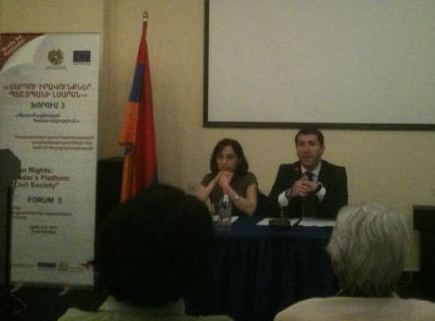
Human Rights. Defender’s platform. Civil Society

On 3-4 June 2011 Office of the Human Rights Defender of the Republic of Armenia (HRDO) convened already third forum in series of forums entitled “Human Rights. Defender’s Platform”. This time forum entitled “Civil Society” was dedicated to the partnership with civil society organizations and brought together 130 participants from more than 85 human rights NGOs, international organizations, attorneys and media. Forum was supported by the European Union, World Vision Armenia and Organization for Security and Co-operation in Europe.

The aim of the “Civil Society” Forum was to strengthen cooperation and promote active dialogue between the Office of the Human Rights Defender and leading human rights NGOs specialized in the issues of minorities, refugees, children, disabled people, women, military servicemen, rights of persons in detentions and penitentiaries, environmental rights, rights of the persons suffered from violence and torture as well as NGOs promoting the right to a fair trial and the right to freedom of expression.

Followers of @pinkarmenia twitter had possibility to read live tweets of our representative, Mamikon Hovsepyan, who used #CSforum and #HRArmenia as hashtag for those tweets. Below you can read the most important ones.

Day one, July 3

starting the "Civil Society" forum in Tsaghkadzor, organized by Armenian Ombudsman

the Ombudsman takes the floor, presenting his welcome speech

Karen Andreasyan, Ombudsman, mentioned that they specifies 11 spheres to work with

Karen Andreasyan finalized his speech, asking for civil society's support for Ombudsman further work

Raul de Luccenberger, EU representative told that we should be proud to have such an important institution as Ombudsman office in Armenia

once students asked to EU representative, What is the way for Armenia to become an EU member, he answered "To believe"

OSCE will support Ombudsman office for its strengthening and cooperation with human rights defender organizations

representative of National Security Council presenting their strategic plan to protect human rights in Armenia

during the private conversation with Mamikon Hovsepyan, the National Security Council representative denied that Baghdasaryan is homophobe

now Civil Society representatives are presenting human rights violations in 11 spheres mentioned by Ombudsman

FYI: LGBT situation won't be presented, PINK was informed few days ago when the agenda was ready and no changes where available

changes: Ombudsman will sign a separate memorandum with PINK, before it was decided to have with national minorities

organizational side of the forum is a bit weak, but to compare with previous, this ombudsman is better

court, judges, police, juridical institutes... we need changes in this sphere, we need to monitor their work and demand JUSTICE

gender roles: women's participation in decision making, in parliament, in government and high levels is weak

Susanna Vardanyan from Women's Rights Center presenting 3 main types of violence against women: physical, psychological, sexual

S. Vardanyan also talks about the case of Zaruhi Petrosyan, CSVW coalition's work and CS initiatives about the changes of law

mass media representative where beaten, are being beaten and will be beaten until we dont have strong law for freedom of speech

A. Musheghyan: After car accident I couldn't walk anymore, i sent back home from hospital and couldn't reach the 5th floor

Musheghyan: If I become a parliamentarian how can I go to work, they have no conditions for handicapped people

there are 183000 handicapped people in Armenia and 100.000 of them are able to work but they don't work

Ombudsman left the room after the official part of the meeting, some participants call it lack of respect toward civil society

PINK: everybody at this forum talks about respect, tolerance and cooperation but do they all respect others and their rights? Not sure

Most of the speakers didn't understand that it is not an NGO presentation but situation presentation of their sphere

Artak Kirakosyan, CSI, asked the vise-president of Collaboration for Democracy, Mikayel Baghdasaryan to leave the forum as he violated women

As A.Kirakosyan mentioned, Mikayel Baghdasaryan, has beaten his female colleague & more

the last speaker, the main hate speech promoter Karine Danielyan

homophobe Karine Danielyan about human rights. Funny

Karine Danielyan is talking about her sphere, ecology. In other meetings she forgets about her responsibilities, promoting hate

 Day two, July 4

starting discussions with the working groups, felt ignorance & dislike from the side of national minorities toward LGBT issues

human rights defenders of national minorities do not want to see Muslim women with covered head in Armenia

they said national minorities should leave accepting Armenian rules but the still speak about xenophobia

national minorities put their problems next to general problems in Armenia and do not talk about nazism and racism

representative of Jewish minorities said that National Security Council should take care of LGBT issues in Armenia

national minorities want to raise the law of hate speech which was suggested Mamikon Hovsepyan

hardly but finally representatives of national minorities see their problems & in some cases put LGBT rights next to it

Yezidi representative demands places at national assembly, other national minority representative don't care about it

Mamikon asked the representatives of national minorities to accept diversity and respect all kind of human rights

working groups finalized discussions, presentation will be prepared and introduced to the Ombudsman and participants

K. Andreasyan: "There are many other human rights organizations in Armenia but we trust those who are here now"

1. human rights protection in armed forces

2. judicial rights: including issues of fair trials and justice

3. women's rights: women's involvement in politics, women's role in social advertisements, violence against women

4. freedom of speech: including involvement of NGOs in the work regarding freedom of speech

5. rights of handicapped people (people with fewer opportunities)

6. rights of people faced violence and torture: specified mainly in police stations, it was suggested to mention that National Security office is also violating people as in police stations

7. rights of people in prisons

8. children's rights: among other problems was mentioned violence, especially sexual abuse against children

9. Minorities: national, religious, sexual, though there was no representative from religious minorities

10. refugees

11. Environment

first time ever in official document Armenia will use Armenian word to refer LGBT issues

Environment group boycotts and will not sign memorandum, Hope it is not K. Danielyan's idea against LGBT rights protection

June 4, the first ever Armenian document with Armenian terms to protect the rights of LGBT people in Armenia

April 9, 2011

Report: discrimination and societal abuses

Section 6 of Human Rights Report by the U.S. Department of States. Armenia, 2010
The constitution and law prohibit discrimination based on race, gender, disability, language, or social status; however, the government did not effectively enforce these prohibitions in practice.

Women

Rape is a criminal offense and carries a maximum penalty of 15 years' imprisonment. There are no explicit laws criminalizing marital rape. According to police information cited by the Prosecutor General's Office, nine cases of rape and attempted rape were registered in the country during the year. In connection with these cases, nine individuals were prosecuted, seven were convicted, and two cases were still under investigation. According to official information, none of these reported cases constituted marital rape. Crimes such as rape continued to be underreported due to the social stigma attached to them.
There is no law against domestic violence. Few cases of spousal abuse or other violence against women were reported during the year, although such violence was believed to be widespread.
According to domestic observers, most cases of domestic violence continued to go unreported because victims were afraid of physical harm, were apprehensive that police would return them to their husbands, or were ashamed to disclose their family problems.
On October 1, police launched an investigation into the death of 20-year-old Zaruhi Petrosian, a resident of the town of Masis, who was hospitalized late on September 30 with a brain hematoma, a broken finger, and bruises on her body. The police subsequently arrested Yanis Sargisov, Petrosian's common law husband, on charges of willful heavy damage to health leading to death by negligence. The criminal investigation was later transferred to the investigation department of the Ministry of Defense in light of Sargisov's service in the armed forces. According to Hasmik Petrosian, Zaruhi Petrosian's sister, Zaruhi had long been physically abused by her husband and mother-in-law. Officials stated the investigation could not corroborate abuse by the mother-in-law. At year's end, the investigation of Sargisov continued while he remained in custody. Petrosian's child remained in an orphanage while the mother-in-law and Petrosian's sister both claimed custody of the child.
In March the domestic Women's Resource Center Armenia (WRCA) NGO launched a public awareness campaign to advertise its Sexual Assault Crisis Center and help hotline. The Yerevan municipality eventually rejected the organization's application to advertise the center on large commercial billboards, on the grounds that the billboard graphics would place unnecessary psychological stress on teenagers and women. The municipality then took steps to remove all WRCA's advertising. The WRCA asserted that, by limiting the billboards to providing only the help hotline number, the municipality reduced the effect of its advocacy against sexual assault of women.There were reports that women, especially those in rural or remote areas, faced insufficient access to adequate general and reproductive health-care services. Observers noted various efforts made to improve reproductive health care had not been effective.

Children

On January 11, the Prosecutor General's Office began a criminal investigation of allegations of sexual and physical abuse of female students by a teacher at Special School No. 11 for children with special needs. This action reversed the office's August 2009 determination the allegations were unsubstantiated. A group of youth activists who served as volunteers at the school raised the initial alarm of abuse in 2008. On May 24, the trial court convicted former teacher Levon Avakian, who admitted his guilt, to two years in prison. On May 31, the Ministry of Education and Science dismissed the principal, Meruzhan Yengibarian, citing lack of trust in his capacity to head the school. The youth activists considered the teacher's punishment to be too lenient and called for further investigation into the role played by the principal and other teachers, who were reportedly aware of but did not prevent the abuse. On August 4, following an appeal by the victims, the court of appeals increased Avakian's sentence to three years.
A 2009 study by the domestic NGO Armenian Helsinki Committee monitored 12 special education schools and four boarding institutions. Many children indicated that, among other forms of punishment, they had been slapped or beaten, shut in a classroom, or prevented from going home. Some teachers admitted resorting to violence for discipline. The study also noted that most institutions lacked proper central heating, and that sanitary and hygiene conditions were substandard. In a study of 12 general education schools in the Syunik Region during the same period, the NGO found that physical or psychological violence, including beating, slapping, pulling ears, and other degrading treatment were used regularly as punishment. Treatment of students at schools was unequal and depended on teachers' relations with students, whether students pursued private classes with a teacher, and whether students had influential parents. The results of studies in 2007 and 2008 by the same organization were substantively the same.

Persons with Disabilities

The law prohibits discrimination against persons with disabilities in employment, education, access to health care, and the provision of other state services; however, discrimination remained a problem. The law and a special government decree provide for accessibility to buildings, including schools, for persons with disabilities, but in practice very few buildings and other facilities were accessible to these persons. The Ministry of Labor and Social Affairs is responsible for protecting the rights of persons with disabilities but failed to do so effectively.
In spite of the large number of officially registered persons with disabilities in the country, disabled persons are seldom seen outside the home due to the social stigma associated with disabilities. In extreme cases the social stigma sometimes prompts families to hide their disabled children completely from public view, depriving them in the process from access to education and integration into society.
Persons with all types of disabilities experienced problems in virtually all spheres of life, including health care, social and psychological rehabilitation, education, transportation, communication, access to employment, and social protection. Access to information and communications was a particularly significant problem for persons with sensory disabilities. Hospitals, residential care, and other facilities for persons with serious disabilities remained substandard. According to official data, more than 90 percent of persons with disabilities who were able to work were unemployed.

Societal Abuses, Discrimination, and Acts of Violence Based on Sexual Orientation and Gender Identity

Societal attitudes towards homosexuality remained highly unfavorable, with society generally viewing homosexuality as an affliction.
Persons who were openly gay were exempted from military service, purportedly because of concern they would be abused by fellow servicemen. However, the actual exemption required a medical finding via psychological examination that gays possessed a mental disorder, which was stamped in their documents and could affect their future.
According to human rights activists, lesbians, gays, bisexuals, and transgender persons experienced some of the most humiliating discrimination in prisons, where they were forced to do some of the most degrading jobs and separated from the rest of the prison population.
Societal discrimination based on sexual orientation continued to be a problem with respect to employment, family relations, and access to education and health care for sexual minorities.
In an interview with the Iravunk biweekly that appeared in the newspaper's December 24 to 27 edition, Artur Baghdasarian, secretary of the National Security Council that advises the president on national security matters, answered a question on homosexuality stating that, "Such conduct does not fit in with our society. Family and Armenian traditions prevail for people who were the first to adopt Christianity. Those unnatural things are unacceptable to us. I am against limitations of human rights in general. However, I consider homosexuality is extremely dangerous for Armenia."
In an interview in the Hraparak daily on December 6, National Police Chief Alik Sargsyan answered a question on the gathering of homosexuals in one of Yerevan's central parks, stating that, "We try to take them to such a place where they won't be seen, but they like to appear in public. We do not practice any violent measures, do not violate human rights, it is their business, but in our city, it is not appropriate for people…I cannot bear them physically."

Other Societal Violence or Discrimination

There were no reports during the year of acts of societal violence or discrimination against persons with HIV/AIDS.
Many employers reportedly discriminated against potential employees by age, most commonly requiring job applicants to be between the ages of 18 and 30. While this discrimination appeared to be widespread, authorities did not take any action to mitigate it. After the age of 40, workers, particularly women, continued to have little chance of finding jobs appropriate to their education or skills.

for the full version of the report, please click here

October 25, 2010

"Stop violence" with... violence. P.S. re recent abuse and violence scandals in Armenia

via Unzipped

Starting with the case of that Nubarashen school pedophile teacher, then army and school abuse videos, and then the highly publicised recent domestic violence case, what I noticed - not infrequently - that some people, even among ‘stop violence’ campaigners, in the heat of emotional debate call for lynching of those suspected in abuse or violence.

Yes, it’s understandable that emotions may run high, and things may be said (but not meant to) in the midst of heated debate or as an immediate emotional reaction to horrific crimes.... But you simply can’t fight violence with violence. This will not solve any problems. Instead, it will ensure a vicious circle of everlasting violence.

Let’s take a very recent example of domestic violence in Armenia, that rightly resulted in an outrage, and petition was launched (I supported and signed it) calling for law against domestic violence.

In total, there were 3196 signatures with/without comments, now passed to the prime minister.

A friend of mine disturbed by certain comments posted on the petition 'Armenia Must Pass Domestic Violence Legislation', compiled a list of all of those signatories (28 in total) who "wished bodily violence and death upon the husband and/or mother-in-law of Zaruhi Petrosyan". He rightly pointed out that “we need to prevent domestic violence, not practice lynch mob rule”.

It is also disturbing that a person (e.g. petition signatory 3179, screenshot below) would use a slanderous and bigoted term about a sexual minority group to express his anger over a domestic violence issue. This ‘injustice by injustice’ approach totally devalues his own signature.


Thankfully, 28 comments make up less than 1% of the total number of signatories.

Interesting geographical distribution of such comments: 22 of the 28 comments came from California(!); 2 from Armenia; 1 from Turkey, Australia each; and 1 from the states of Wisconsin and Florida each. As friend commented, “Americans seem to be the most 'stop violence with violence' people...in a country where the death sentence is practiced regularly, but I am not sure about in California....”

Below are just few selected extracts to demonstrate the point.
No. 3,152 They should be thrown in jail and beaten so it's a lesson to others.
No. 2,787 I would beat the living hell out of this prick and set his mother on fire!
No. 2,763 That man and his disgusting mother should be beaten the same way and crushed to death.
No. 2,553 Maybe it's not only time to sign a petition, maybe it's time to personally fight back. Go get your bats and your guns, grab your pots and your pans, they work too, and turn around and do what Madea says. Beat them back!!
No. 2,406 This mother and son should be charge with first degree murder and death penalty sentense for them they should hang in middle of town
No. 1,815 Put a piece of cloth in his mouth take him toYerevan city square and pull his nails in front of the public then hang him
Or, for example, No. 484:
In the past, I heard of Arab females being stoned to death and even seen a true story about it "The Stoning of Soraya M". But I never heard an Armenian version of it. I can't believe beating an individual to death still occures with a mother-in-law having to be the main suspect.
Saying that, and presumably considering it deploring, she then continues:
It's sad to say, but in my personal opinion I believe she should get beaten the same way and let along to die. Don't only stick a dirty peice of cloth in her mouth, but stick in up her ass. The mother-in-law as well as her xangarvats son need to die exectution style. The best method for these types of people is Iranian style "stone to death".
Rule of law, education, trainings, changes in law, and similar measures... that's what I'd like to see instead.

September 23, 2010

Support women living with HIV

Each culture during different periods of its history perceived gender and sexuality in a unique way. In fact our understanding about gender norms and sexuality is formed under the influence of various factors, such as traditions, policy, and religion. This gender roles and stereotypes have their influence on the circumstance how man and women behave during sexual relations.

Today in Republic of Armenia girls and women face gender discrimination, including gender violence, they are forced to implement traditional roles, have limitations in family planning possibilities.

Each of us has sexual rights, which includes sexual education, right to get information about infections and healthcare. Existing traditions and stereotypes about gender roles do not give an opportunity to women and girls to ensure the realization of their sexual and reproductive rights. The society expects woman to have passive role in issues regarding sexuality. As a rule women are criticized, stigmatized and discriminated if they try to make decisions with regard to their sexual life. The society does not accept when woman tries to take care of her health, have safe sexual behavior, make decisions about family planning due to the prejudiced attitude toward women’s active role in sexual life.

In case if we talk about gender equality and that each member of the society has to have equal opportunities, this kind of attitudes must be changed. When we talk about gender equality we can’t miss the fact that equality must be in all spheres of life including sexual life. There is a need to eliminate discrimination and break stereotypes by ensuring woman’s sexual and reproductive rights. Women have right to get appropriate, comprehensive information and education about sexual and reproductive health, which will give them an opportunity to make balanced decisions about their sexual life, protect their and their future children’s health.

The gaps in sexual and reproductive health education and vulnerable state of rights lead to the situation where many people in Armenian society do not consider themselves vulnerable in terms of HIV. Due to stereotypes and prejudice woman does not have a right to make decisions about her sexual and reproductive health, which makes her double vulnerable.

So we can conclude that societal stereotypes about the role of woman in sexual life put her and her future baby’s health under a threat and under the risk to be infected by HIV.

When we talk about woman vulnerability in terms of HIV there is a need to talk about female sex worker’s vulnerable and endangered situation as well. Sex workers face stereotyped and discriminative public attitude, which leads to their marginalization in the society. That brings to the vulnerable state of sex workers with regard to HIV infection.

Sew workers are not protected by law. They are not protected from violent actions of the ones who use their services. Those sex workers who undergo violence have few chances to be protected by the state. The lack of protection put sex workers under the risk of violence and in such environment HIV can easily spread.

It is also important to mention that due to stereotypes sex workers are deprived from healthcare, legal and social services. Due to discrimination and stereotypes they can have fear of applying to appropriate services. In this case they are more possessed to be infected by HIV and transmit it to the ones who use their services.

Marine Margaryan

July 19, 2010

Now more than ever: human rights march and rally

The Human Rights and HIV/AIDS: Now More Than Ever campaign will march and rally for human rights at 18th International AIDS Conference on July 20, 2010 in Vienna.

Internationally acclaimed singer songwriter and long-time AIDS activist Annie Lennox will headline an historic rally in downtown Vienna. The march and rally will feature a memorable live musical performance by Lennox and provide an opportunity for people to demonstrate their commitment to protecting human rights and stopping the spread of HIV.

The event will consist of a 30-minute peaceful march in downtown Vienna to a public rally with government leaders, human rights and AIDS advocates, and people affected by HIV. Following the speeches, Annie Lennox will give a special presentation of her SING Campaign, which will include a musical performance and some short films highlighting the issues that surround HIV and AIDS.

The event will highlight the central role of human rights in the response to HIV. It will focus on the human rights of people living with HIV and of those affected by HIV, especially women and young people, gay, lesbian, and transgender people; and people who engage in sex work or who use drugs. It will focus on the global AIDS struggle as well as pressing concerns in Austria.

"Together we will give a voice to the voiceless," Annie Lennox.

March 6, 2009

Armenian human rights activist Lilit Poghosyan is chosen as the face for the EU anti-discrimination poster


Do you know your rights?

53% of Europeans don’t know they’re protected from discrimination in the workplace. [Eurobarometer survey on discrimination in the European Union – Perceptions, experiences and attitudes (July 2008)]

Laws exist throughout the EU to protect everyone against discrimination based on race or ethnic origin, age, disability, religion or belief, or sexual orientation in the workplace.

*This poster has been produced as part of the EU-wide “For Diversity. Against Discrimination” information campaign. Organised by the European Commission’s Directorate General for Employment, Social Affairs and Equal Opportunities, the campaign aims to raise awareness of discrimination and the EU laws which exist to combat it, and to promote the benefits of diversity.

What is even more pleasing for me regarding this poster is that Lilit Poghosyan is a good friend of mine. Well done, Lilit jan! I am proud of you and of being your friend.

Lilit joined Europe’s main gay rights group - ILGA-Europe (as Programmes & Policy Officer) in October 2008.

Lilit is responsible for the Advocacy Project which aims to strengthen the advocacy capacities and competences of project partners. She also monitors the developments in the field of human rights of LGBT people in Western Balkans and Turkey and channels the information on human rights violations on the grounds of sexual orientation and gender identity to relevant EU institutions in order to ensure that LGBT people enjoy equal rights and protection in candidate and potential candidate countries for the accession to the EU.

Lilit holds a degree in Psychology and Education and has completed her MSc in Human Rights at London School of Economics in 2005. She has eight years work experience in field of sexual, reproductive and mental health of which around six years in Médecins Sans Frontières (Doctors Without Borders) field projects in Armenia, Kashmir/Pakistan, Zambia and Uganda.